


Steel and reinforced cement concrete (RCC) are two of the most widely used structural systems in modern construction. Both can provide strong, durable and reliable buildings when properly designed and constructed. However, they behave differently and offer different advantages in terms of weight, construction speed, flexibility, durability, fire performance, maintenance and cost.
Choosing between steel and RCC is therefore not simply a matter of deciding which material is stronger. The appropriate system depends on the building’s size, location, architectural requirements, construction schedule, available skills, environmental conditions and project budget.

What Is an RCC Structure?
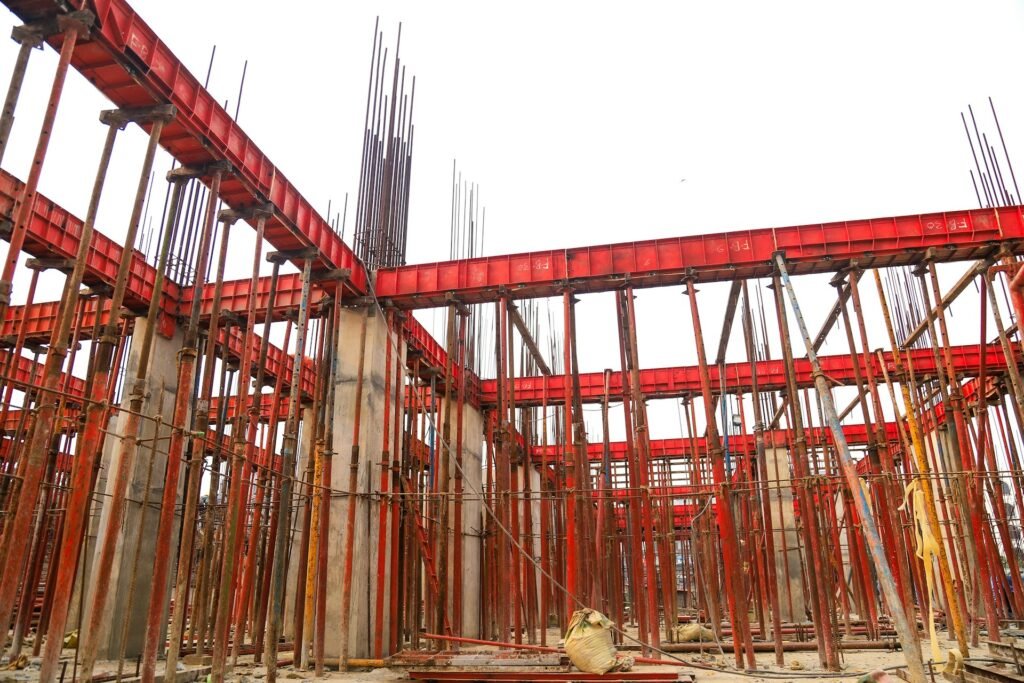
RCC stands for Reinforced Cement Concrete. It combines concrete, which performs well in compression, with steel reinforcement, which provides tensile capacity.
RCC is commonly used for:
- Foundations
- Columns
- Beams
- Slabs
- Shear walls
- Retaining structures
- Staircases
The concrete protects the reinforcement and provides stiffness and compressive strength, while the reinforcement helps the structural member resist tension and bending.
What Is a Steel Structure?
A steel structure uses structural steel members as the primary load-carrying elements.
Common components include:
- Steel columns
- Beams
- Bracing systems
- Trusses
- Steel frames
- Connections
- Decking systems
Steel structures are widely used in industrial buildings, warehouses, commercial buildings, bridges and some high-rise structures.
Structural Weight
One of the major differences between the two systems is their weight.
Steel has high strength relative to its weight, allowing structural members to carry substantial loads without becoming excessively heavy.
RCC structures are generally heavier because concrete has a relatively high density.
A lighter structural system can reduce the loads transferred to foundations, although the actual foundation benefit must be established through structural analysis.
Construction Speed
Steel construction can be very fast when members are fabricated in advance and delivered to the site ready for erection.
Much of the fabrication can take place in a controlled factory environment while foundation or other site activities are progressing.
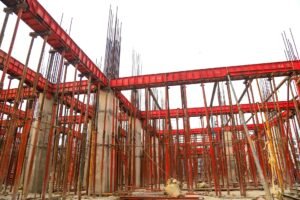
RCC construction generally involves:
- Formwork
- Reinforcement placement
- Concrete placement
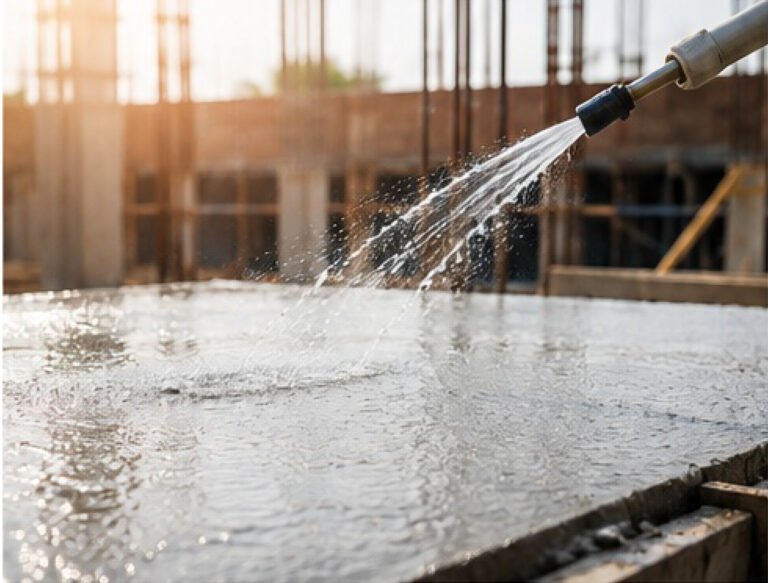
- Curing
- Formwork removal
These activities require careful sequencing.
For projects with very tight construction schedules, steel can therefore offer significant advantages.
Architectural Flexibility
Steel provides considerable flexibility for large column-free spaces.
This can be useful for:
- Warehouses
- Factories
- Exhibition halls
- Airports
- Large commercial spaces
- Sports facilities
RCC can also create large spans, but achieving them may require deeper beams, post-tensioning or other specialised structural systems.
The architectural requirements should therefore be considered before selecting the structural system.
Strength and Structural Performance
Both steel and RCC can provide excellent structural performance when properly designed.
Steel has high tensile and compressive strength and can be particularly efficient for long-span structures.
RCC provides high compressive capacity and substantial stiffness.
The choice depends on the structural behaviour required for the particular building rather than on material strength alone.
Seismic Performance
In earthquake-prone areas, structural weight, ductility, stiffness and detailing are important considerations.
Steel structures can provide high ductility when appropriately designed and detailed.
RCC structures can also perform very well during earthquakes when designed according to the applicable seismic requirements and constructed with proper reinforcement detailing.
The structural engineer must consider the local seismic hazard and applicable design codes.
Fire Resistance
Fire behaviour is an important consideration for both systems.
Concrete generally has good inherent fire resistance because it is non-combustible and provides protection to reinforcement.
Structural steel does not burn, but its strength and stiffness can decrease significantly as temperature increases.
Steel structures may therefore require fire-protection systems such as:
- Fire-resistant coatings
- Encasing
- Spray-applied protection
- Board systems
The required protection depends on the building design and applicable fire regulations.
Durability
RCC can provide long service life when concrete quality, reinforcement cover, exposure conditions and construction practices are properly controlled.
Steel can also have a long service life, but corrosion protection is particularly important.
Steel may require:
- Protective coatings
- Galvanising where appropriate
- Proper drainage
- Inspection
- Periodic maintenance
Moisture and aggressive environments should be considered during design.
Corrosion Considerations
Corrosion can affect both structural systems, but the mechanisms differ.
Steel is directly vulnerable to corrosion when exposed to moisture and oxygen without adequate protection.
In RCC, reinforcement can corrode if aggressive agents penetrate the concrete and reach the reinforcement.
Good concrete quality, adequate cover, proper detailing and appropriate durability design are therefore essential.
Foundation Requirements
The weight of the superstructure influences foundation design.
Because steel structures can be lighter than equivalent RCC structures, they may sometimes impose lower foundation loads.
This can be advantageous where soil conditions are weak.
However, foundation design depends on many factors, including:
- Building loads
- Soil bearing capacity
- Settlement
- Wind loads
- Seismic forces
- Foundation type
The actual foundation requirements must always be established through geotechnical and structural design.
Construction Site Requirements
Steel construction can reduce some wet construction activities.
Factory-fabricated steel members can arrive at the site ready for erection.
RCC construction requires concrete, reinforcement and formwork operations at the site.
This can make site logistics more demanding, particularly where access is restricted.
However, modern construction techniques have improved the efficiency of RCC construction considerably.
Quality Control
Steel fabrication can be performed under controlled factory conditions.
Dimensions, welds, bolt holes and other components can be inspected before delivery.
RCC quality depends significantly on site practices such as:
- Reinforcement placement
- Formwork accuracy
- Concrete batching
- Concrete transportation
- Placement
- Compaction
- Curing
Strict quality control is essential for both systems.
Maintenance Requirements
RCC generally requires relatively low routine structural maintenance when properly designed and protected.
Steel structures require regular inspection of:
- Protective coatings
- Connections
- Corrosion
- Fire-protection systems
- Drainage details
Maintenance requirements can vary considerably depending on environmental exposure.
Cost Considerations
It is difficult to say that steel is always cheaper or RCC is always cheaper.
The overall project cost depends on:
- Material prices
- Labour costs
- Building size
- Span requirements
- Construction speed
- Transportation
- Equipment
- Foundation requirements
- Fire protection
- Finishing
- Maintenance
Steel may have a higher material cost but can reduce construction time.
RCC may have competitive material costs but require longer construction cycles.
A complete project-level cost comparison is therefore more meaningful than comparing the price of steel and concrete alone.
Environmental Considerations
Both materials have environmental impacts.
Steel production requires substantial energy, but steel has a significant advantage in recyclability.
Concrete production, particularly cement manufacturing, is associated with substantial greenhouse-gas emissions.
However, environmental performance depends on the entire building life cycle.
Factors such as:
- Material quantity
- Service life
- Transportation
- Maintenance
- Reuse
- Recycling
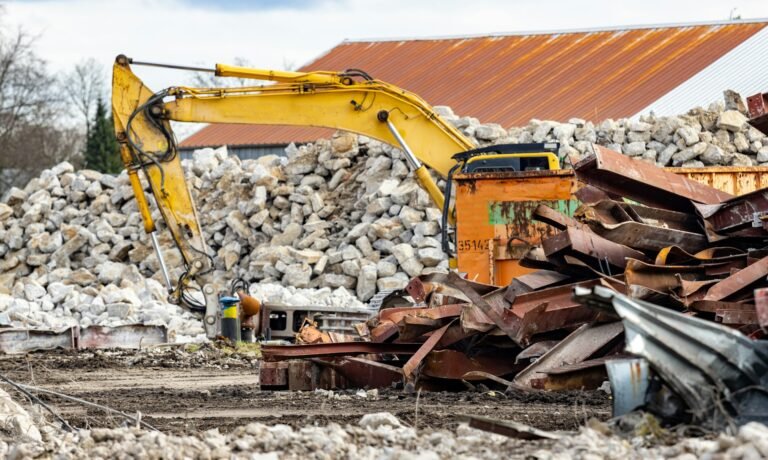
- Demolition
should be considered when comparing structural systems.
Availability of Skilled Labour
RCC construction is widely understood by construction workers in many regions.
Steel construction requires skilled fabrication, welding, bolting and erection teams.
The availability of experienced contractors can therefore influence the choice.
A technically excellent structural system may not perform as expected if the project lacks the necessary construction expertise.
Construction Equipment
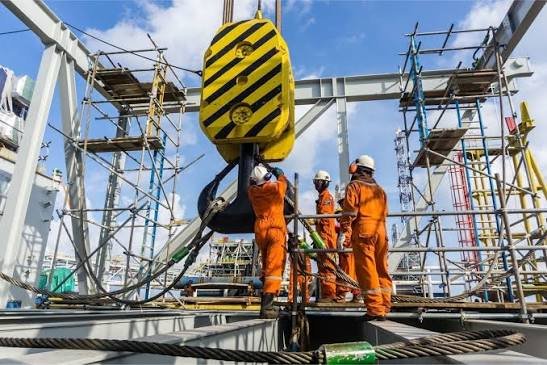
Steel erection may require cranes, lifting equipment and appropriate access.
RCC construction requires equipment such as:
- Concrete mixers or batching plants
- Concrete pumps
- Vibrators
- Formwork systems
- Reinforcement equipment
The equipment required depends on the size and location of the project.
Hybrid Structural Systems
Steel and RCC do not always have to compete against each other.
Many modern buildings use composite or hybrid structural systems.
Examples include:
- Steel beams with concrete slabs
- Steel columns with concrete cores
- Composite floors
- RCC foundations supporting steel structures
Combining materials can allow designers to take advantage of the strengths of each system.
Where Steel Structures Are Often Suitable
Steel can be particularly attractive for:
- Industrial buildings
- Warehouses
- Large-span structures
- Factory buildings
- Exhibition halls
- Buildings requiring rapid erection
- Structures requiring future modification or expansion
The final suitability depends on structural and architectural requirements.
Where RCC Structures Are Often Suitable
RCC is widely used for:
- Residential buildings
- Apartment buildings
- Office buildings
- Schools
- Hospitals
- Commercial buildings
- Parking structures
It is particularly practical where conventional concrete construction is readily available and the building has moderate spans and repetitive layouts.
Steel vs RCC: Quick Comparison
| Feature | Steel Structure | RCC Structure |
|---|---|---|
| Structural weight | Generally lighter | Generally heavier |
| Construction speed | Usually faster | Generally slower |
| Large spans | Excellent | Possible with appropriate design |
| Fire behaviour | Requires protection in many applications | Generally good inherent resistance |
| Corrosion | Requires protection | Reinforcement requires concrete protection |
| Factory fabrication | Extensive | Limited compared with steel |
| Site work | Relatively dry erection | More wet construction |
| Modification | Often easier | Can be more difficult |
| Maintenance | Coating and corrosion inspection important | Generally lower routine structural maintenance |
| Recycling | Highly recyclable | Recycling is possible but more complex |
| Local familiarity | Depends on region | Widely familiar in many regions |
How to Choose the Right System
The decision should be made through a structured evaluation rather than choosing a material based solely on initial cost.
The project team should consider:
Building purpose → Span requirements → Height → Loads → Soil conditions → Local climate → Fire requirements → Construction schedule → Material availability → Labour → Cost → Maintenance
The structural engineer can then compare suitable structural alternatives.
Common Mistakes in Structural Selection
Choosing a structural system based only on material price can lead to poor decisions.
Other common mistakes include:
- Ignoring construction time
- Ignoring foundation conditions
- Underestimating fire-protection costs
- Ignoring maintenance
- Choosing a system without considering local expertise
- Failing to coordinate architecture and structure
- Making decisions before understanding the building’s actual loading requirements
A successful project requires coordination between the architect, structural engineer, contractor and developer.
The Future of Structural Construction
The future of building structures is likely to involve greater use of advanced fabrication, digital modelling, prefabrication and composite systems.
Building Information Modelling can help coordinate structural systems before construction.
Computer-controlled fabrication can improve manufacturing accuracy.
Composite construction can combine steel and concrete to achieve efficient structural performance.
These developments are making the choice between materials increasingly flexible.
Conclusion
Steel and RCC are both highly capable structural systems. Neither can be considered universally superior.
Steel can offer advantages in speed, long spans, lightweight construction and prefabrication.
RCC can offer advantages in stiffness, fire resistance, durability and widespread construction familiarity.
The right choice depends on the specific project. Building size, structural loads, soil conditions, architectural requirements, construction schedule, local resources, fire regulations and life-cycle cost should all be evaluated before making the final decision.
For many projects, the best solution may not be steel or RCC, but a carefully engineered combination of both.
Choose the Structural System That Fits the Building—not Simply the Material That Looks Strongest.
About The Author







aaaaaaaaaaaaaaaaaaa